Warning: strpos() expects parameter 1 to be string, array given in /home/tfujii46636/tadd3.com/public_html/wp-includes/compat.php on line 423
Warning: strpos() expects parameter 1 to be string, array given in /home/tfujii46636/tadd3.com/public_html/wp-includes/compat.php on line 423
Warning: preg_match() expects parameter 2 to be string, array given in /home/tfujii46636/tadd3.com/public_html/wp-includes/class-wp-block-parser.php on line 252
Warning: strlen() expects parameter 1 to be string, array given in /home/tfujii46636/tadd3.com/public_html/wp-includes/class-wp-block-parser.php on line 324
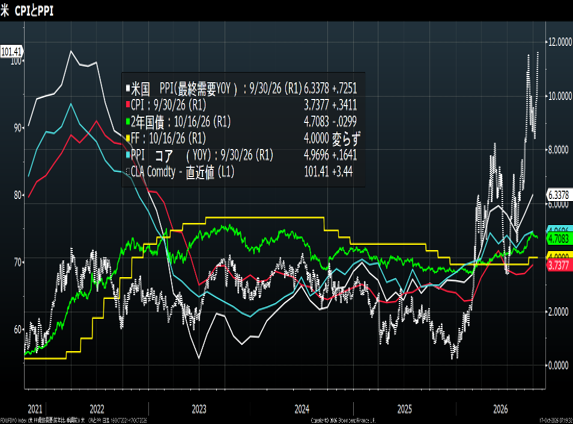
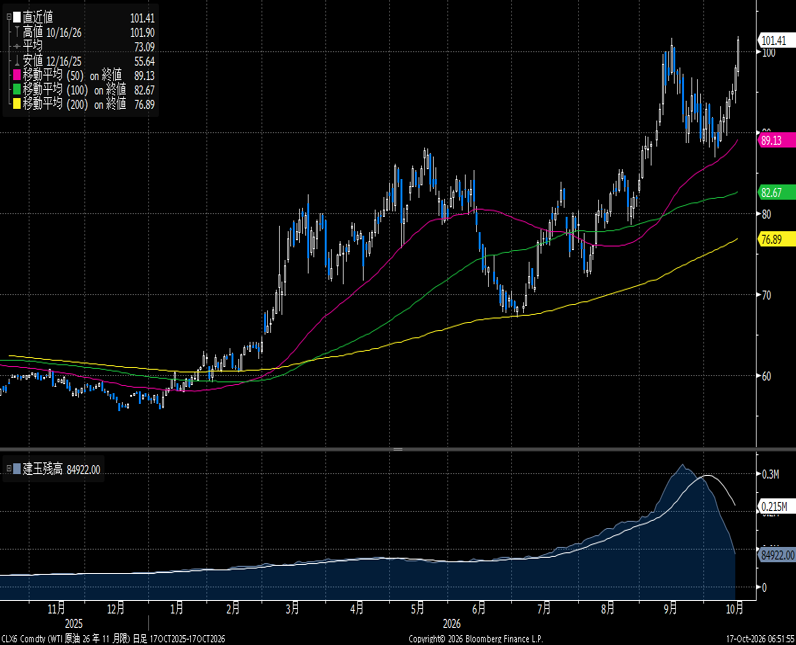
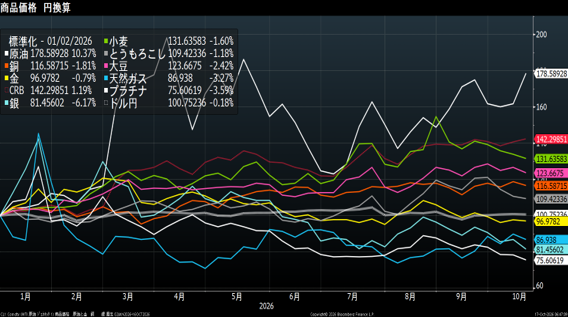
Inflation is rising in both the U.S. and Japan, fueling expectations for interest rate hikes. The U.S. Producer Price Index (PPI) released this week rose by 0.72% to 6.33%. As the PPI serves as a leading indicator for the Consumer Price Index (CPI), this is significant. Crude oil prices—a key driver of inflation—have surged, closing at $101.41 on Friday, a high for the year. Given this environment, both the U.S. and Japan are likely to implement interest rate hikes in December. Japan’s monetary policy, in particular, has lagged behind; therefore, rate hikes are expected to continue into next year and beyond. Considering current inflation levels, it would not be surprising to see policy rates reach 2%.
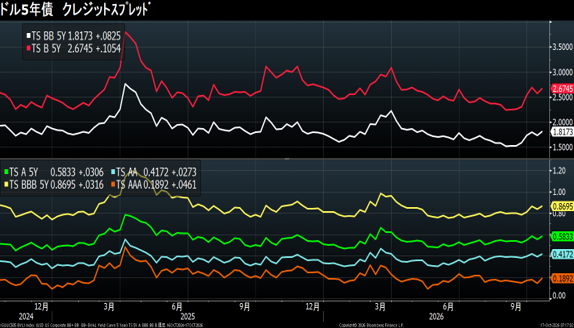
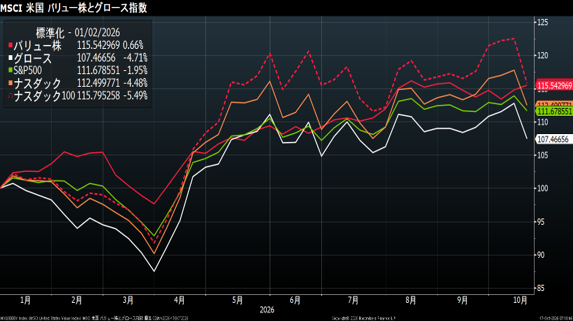
In equity markets, capital is beginning to shift from growth stocks to value stocks in both the U.S. and Japan. In the bond market, corporate bonds are being sold off, with funds flowing into government bonds—a clear “flight to quality.” U.S. high-yield ETFs have hit new lows for the year, and credit spreads on U.S. corporate bonds are widening as capital migrates toward U.S. Treasuries.
The U.S. Treasury yield curve has exhibited a “bull flattening” pattern this week. However, I view this as a temporary movement, as the curve is likely to steepen as inflation persists. While yields on medium-term bonds typically fall more easily than those on long-term bonds, the growing anticipation of rate hikes is preventing medium-term yields from declining. With no signs that crude oil prices—and by extension, inflation—will subside anytime soon, the inflationary trend remains firmly in place. For those looking to invest, U.S. medium-term Treasury bonds are a strong candidate; specifically, the 2-year Treasury note could become an attractive buy if its yield rises above 5%.
〇 U.S. Stock Market: The AI Bubble Bursts
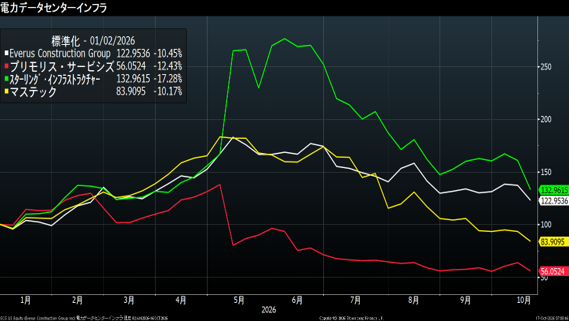
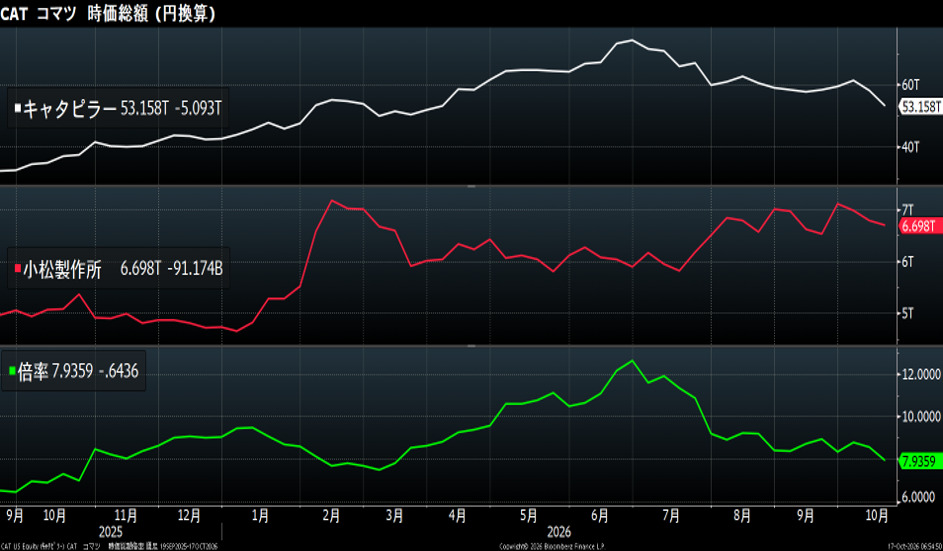
The bubble surrounding AI-related stocks is deflating, with the share prices of companies previously hyped for their AI exposure plummeting. Caterpillar, for instance, has shed its “AI premium,” resulting in the evaporation of 5 trillion yen in market capitalization over the course of a single week. Following this decline, the Caterpillar-to-Komatsu valuation ratio has contracted to 7.9x. The valuation multiple (ER) has declined from a high of 40x to 26.7x.
The stock price has fallen 32% from its peak of $1,073.46.
Given that the company’s performance remains solid, a price below $700 could be an attractive entry point. The next earnings release is scheduled for October 29; until then, the stock is likely to face upward resistance.
〇 Japanese Equities: Value Stocks and Lagging Large-Caps
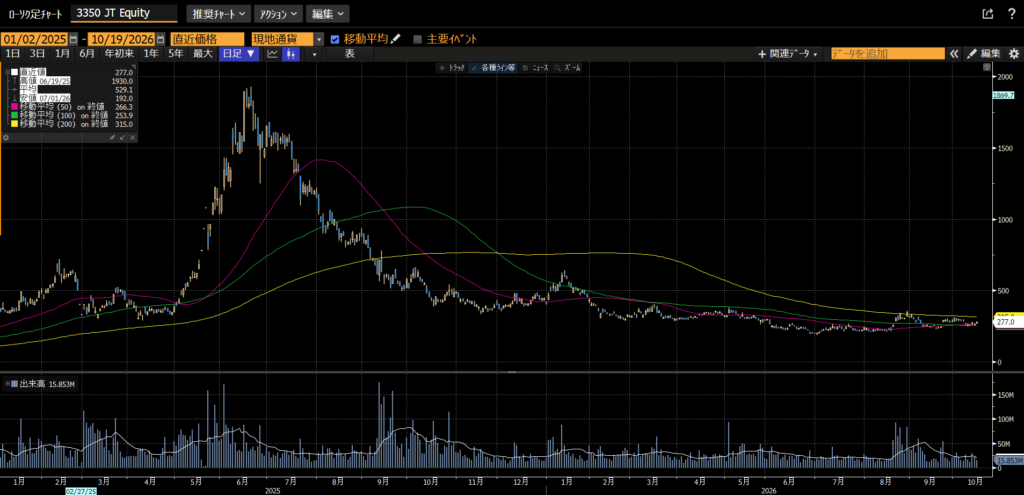
The “semiconductor bubble” is currently bursting within the Japanese equity market. Among the constituents of the Nikkei 225, Kioxia was the most heavily sold stock last week, posting a decline of 23.59% week-on-week. Even so, Kioxia’s year-to-date return remains at 275.88%. Since the selling is driven by supply-demand dynamics, there may be further room for the price to fall; it is best to avoid “bottom-fishing” (speculative buying during a decline). A bold dividend policy might be what’s needed to halt the slide in the share price.
In Japan, the national Consumer Price Index (CPI) is set to be released on the 23rd. Given that the September CPI for Tokyo’s 23 wards—a leading indicator—showed a high year-on-year increase of 2.7%, a similarly strong rise is expected for the national figure.
This is likely to be a negative factor for stock prices.
In the equity market, investors will likely shift toward “safe and secure” large-cap value stocks that offer high dividends. It is probably best to steer clear of the semiconductor and AI sectors, as they still have room to fall further.
〇 MetaPlanet Issues 52 Billion Yen in Euro-Yen Convertible Bonds (Maturing October 2031)
MetaPlanet has issued 52 billion yen in Euro-Yen convertible bonds (CBs). The proceeds are earmarked for debt repayment (23.6 billion yen) and share buybacks (up to 28.3 billion yen, consisting of a base amount of 25.3 billion yen plus an additional 3 billion yen). The conversion price is set at 339 yen (an initial premium of 29.89%), with an issue price of 102.50 against a par value of 100. A notable feature of these CBs is the inclusion of a 160% call option clause. If the stock’s closing price remains at or above 160% of the conversion price for 20 consecutive trading days, the bonds may be redeemed early at face value on or after October 29, 2029. This is subject to providing bondholders with a notice period of at least 30 but no more than 60 days, issued within 30 days of the end of that 20-day period. The call option will not be triggered unless the stock price rises to 543 yen or higher (339 yen × 1.6).
The 25.3 billion yen figure corresponds to approximately 96.93 million shares; if the entire amount of the convertible bonds (CBs) is converted, it would total 153 million shares. Ultimately, this would result in the issuance of 56.45 million new shares (approximately 4.5% of the total shares outstanding).
The accumulation of 52 billion yen is quite significant. While this is not an MSCB (a type of convertible bond often associated with sharp price drops), it is unlikely that the stock price will see much upside in the near term.
〇 India: Gains led by large-cap stocks
Large-cap stocks led a rally—a welcome change, though the market remains in negative territory for the year to date.
For Indian equities, a systematic investment plan (SIP) is the best approach. It is arguably the most promising stock market in the world.
However, the market remains heavily regulated and is not yet fully open to foreign investors.
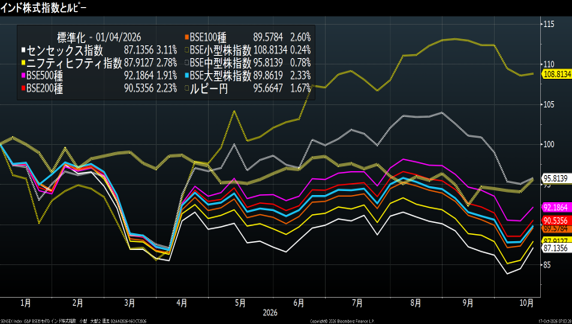
Data: Bloomberg
Certified International Investment Analyst (CIIA)
Certified Manager of Securities Analysts (CMA)
AFP
Tadashi Fujii
投稿者プロフィール

-
大学時代から株式投資をはじめ、証券会社のトレーダーとなる。以後、30年
金融畑一筋。専門分野は債券、クレジット。
日本証券アナリスト協会検定会員(CMA)、国際公認投資アナリスト(CIIA)
詳しいリンク先はこちら
 未分類2026年10月17日A “Flight to Quality” Has Begun
- 未分類2026年10月17日質への逃避が始まった
- 未分類2026年10月11日Will France Become the Next Greece?
- 未分類2026年10月11日フランスは第2のギリシャとなるのか