Warning: strpos() expects parameter 1 to be string, array given in /home/tfujii46636/tadd3.com/public_html/wp-includes/compat.php on line 423
Warning: strpos() expects parameter 1 to be string, array given in /home/tfujii46636/tadd3.com/public_html/wp-includes/compat.php on line 423
Warning: preg_match() expects parameter 2 to be string, array given in /home/tfujii46636/tadd3.com/public_html/wp-includes/class-wp-block-parser.php on line 252
Warning: strlen() expects parameter 1 to be string, array given in /home/tfujii46636/tadd3.com/public_html/wp-includes/class-wp-block-parser.php on line 324
Last week, while the Nikkei Stock Average rose by 2.93% (week-on-week), the TSE Prime, Standard, and Growth markets all posted losses. The top gainers among Nikkei constituents were dominated by semiconductor and AI-related stocks, such as Furukawa Electric, SUMCO, Advantest, Lasertec, SCREEN, Fujikura, and Disco. Advantest, in particular, saw a massive surge of 4,630 yen. Given Advantest’s Nikkei price conversion factor of 6.4 and the current Nikkei divisor of 29.66435840, the stock accounted for 998.90 yen—or 51.3%—of the index’s total 1,945.26-yen gain for the week. The Nikkei remains distorted.
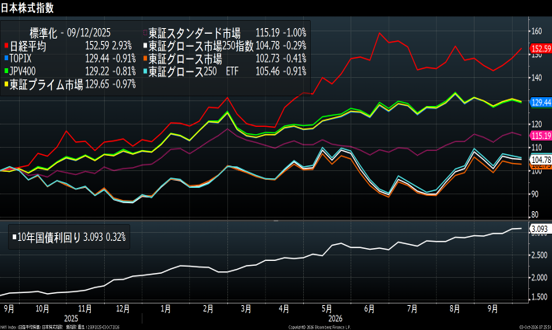
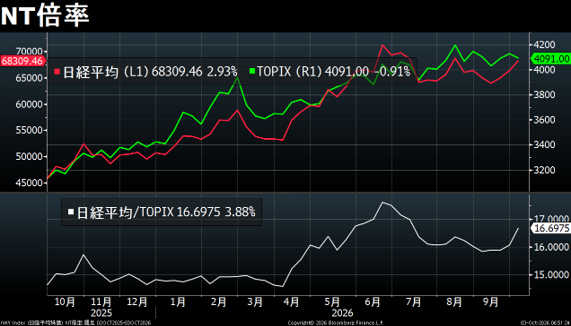
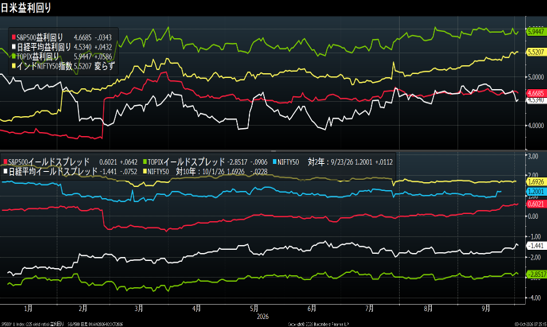
Although the Nikkei rose this week, the TOPIX fell. This caused the NT ratio to widen to 16.69x (up from 16.07x the previous weekend). The Nikkei’s yield spread stood at -1.44%, while the TOPIX was at -2.85%, resulting in a spread of 1.41%. In other words, the TOPIX is undervalued relative to the Nikkei.
Next week is the Special Quotation (SQ) week. Attention will focus on the movements of stocks like Advantest that surged this week. Will the Nikkei break through the 70,000-yen mark, or will it suffer a massive drop? It is a battle driven by the greed of hedge funds.
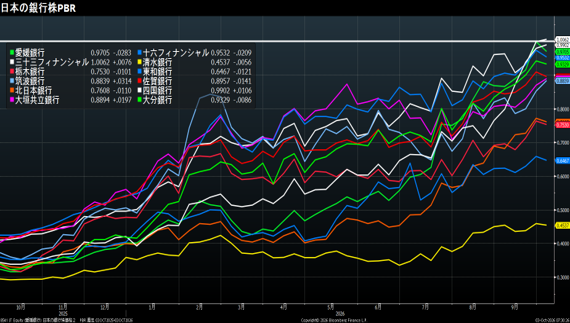
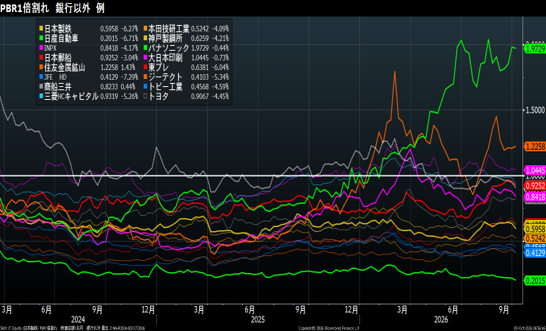
The Nikkei Stock Average is an index that is easily manipulated; with the availability of options and futures, as well as high trading volume, it is well-suited for speculative trading.・Stocks trading below 1x PBR: 552 issues (within the TOPIX index)
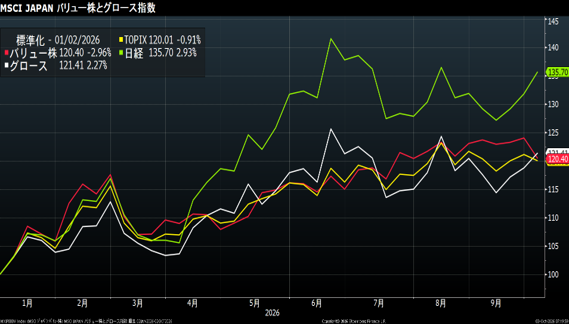
This represents an increase of 55 issues from the 497 recorded on September 25. Value stocks, such as banks, faced selling pressure this week.
The MSCI Japan Value Index fell 2.96%, while the Growth Index rose 2.27%.
Stocks trading below 1x PBR that demonstrate strong earnings performance are attractive targets.
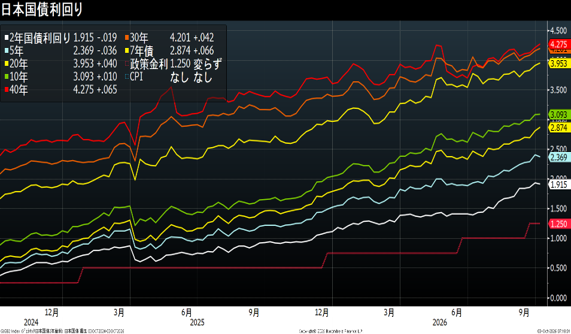
・Bond Market: 2% coupon on newly issued 2-year JGBs
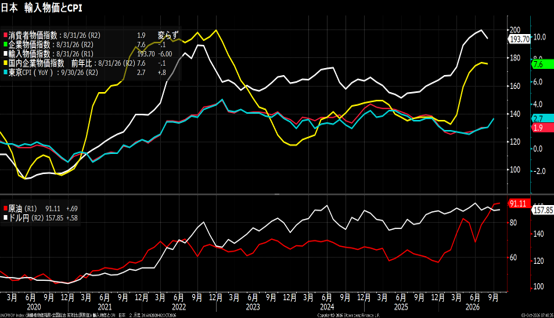
Tokyo’s CPI for September rose to 2.7% (up 0.8% month-on-month), exceeding the Bank of Japan’s 2% inflation target.
Commodity prices—including corn, natural gas, and platinum—declined this week, though crude oil prices remained elevated.
Crude oil prices (in yen terms) have risen 60% year-to-date.
Import prices and corporate goods prices also remain high; the Bank of Japan will likely need to raise interest rates by at least another 50 basis points.
Yields on 10-year Japanese Government Bonds (JGBs) are likely headed toward the 3.5% level.
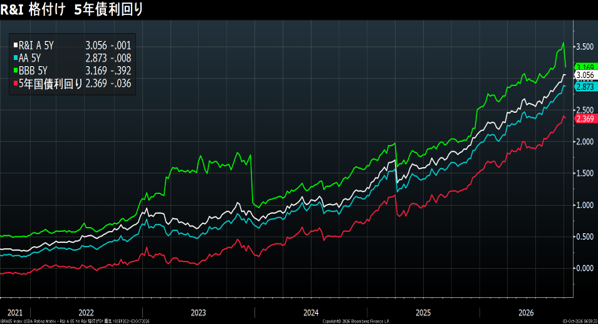
・Japanese Corporate Bonds: Yields on 5-year A-rated bonds in the 3% range
Corporate bond yields are rising alongside JGB yields. Since Japanese companies generally have lower profit margins than their US counterparts, rising interest rates act as a significant burden.
This environment could lead to a revival of the convertible bond (CB) market. Recently, Kobe Bussan issued ¥60 billion in Euro-yen CBs maturing in September 2033, while Shimizu Corporation issued ¥50 billion each in Euro-yen CBs maturing in October 2031 and October 2033.
A key feature of CBs is low issuance cost; depending on the offering price, the cost can even be negative—meaning the issuer realizes a gain from the issuance.
Currently, the CB market is dominated by Euro-yen issues, with no trading activity in the domestic CB market. There is a growing possibility that high interest rates will revitalize the convertible bond (CB) market.
I started my career as a CB trader and am skilled in bond structuring—I wonder if any company might be interested in hiring me?
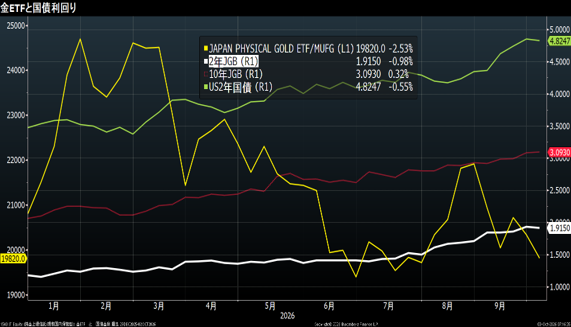
・Gold: Shifting from Gold to Government Bonds
Funds appear to be flowing out of gold. Since gold pays no interest, this is a natural move.
For those buying gold, a systematic accumulation plan (dollar-cost averaging) is the best approach.
・US Stock Market: Relief Over Employment Data
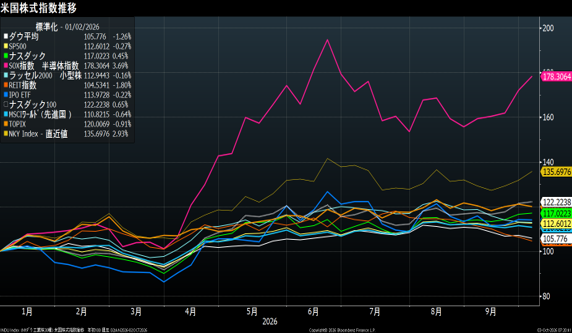
Following the employment data, expectations for interest rate hikes receded; the semiconductor index (SOX) rose 2.4% over the weekend (day-on-day) and 3.69% week-on-week. Meanwhile, the Dow Jones and S&P 500 posted week-on-week declines. Capital in the US market seems to be concentrating on semiconductor-related stocks. CPI data and corporate earnings announcements begin the week after next, suggesting that stock market upside may be limited from next week onwards.
・US Credit: T-Spread Widening
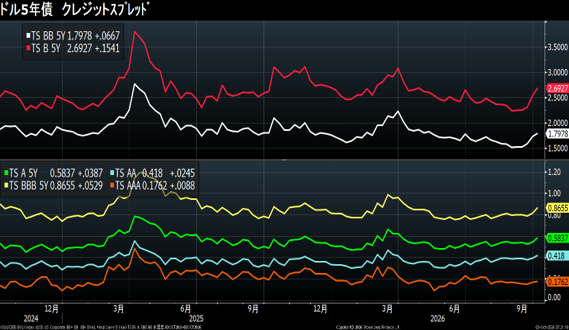
In the US credit market, T-spreads are trending wider as funds flow into government bonds.
The 3-year Treasury yield briefly touched the 5% level, while the 2-year yield stands at 4.8%.
Yields are now at a level where it may be prudent to reduce equity weightings in portfolios.
・Caterpillar-Komatsu Ratio: Widens to 8.79x
Caterpillar shares have been bought while Komatsu shares have fallen, widening the market capitalization ratio to 8.79x.
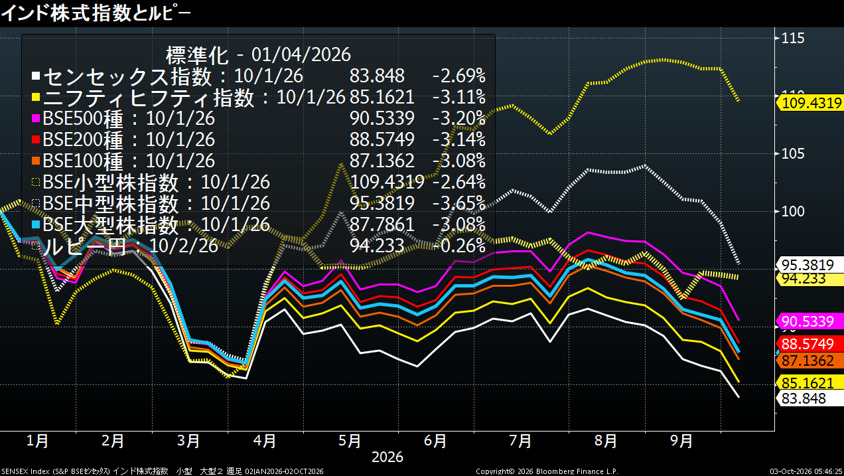
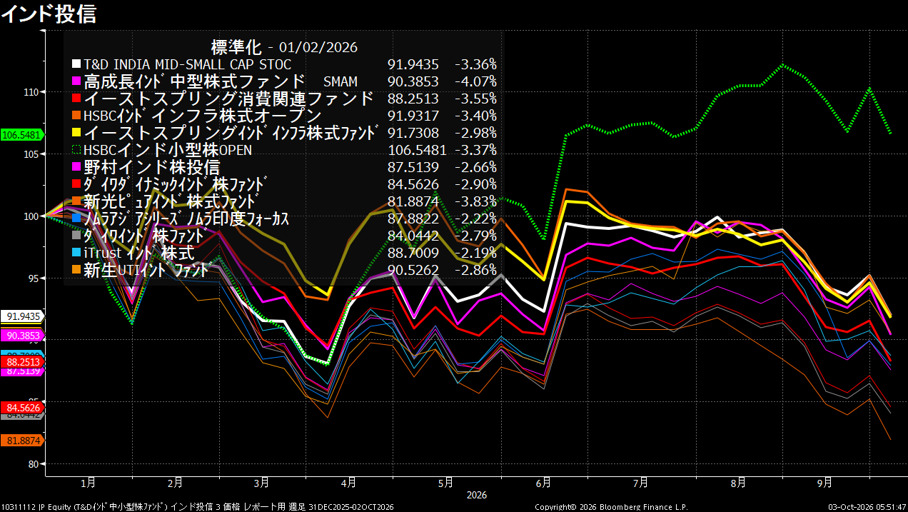
・India: Sensex Hits New Year-to-Date Low
The Indian stock market remains sluggish, with continued capital outflows from foreign investors. Funds are also flowing out of India-focused investment trusts sold in Japan; Nomura’s India equity fund saw a decline of approximately 10 billion yen in a single week, and a drop of about 100 billion yen since the end of last year (when it stood at 438 billion yen).
On the other hand, the domestic IPO market is booming. The average opening price for newly listed stocks has exceeded the initial public offering (IPO) price by approximately 20%. The highest gain was 90%, while the lowest result was a decline of 1.52%.
For information on India:
Orion Global Ventures – Orion Global Ventures
Data: Bloomberg
Certified International Investment Analyst (CIIA)
Certified Securities Analysts Association (CMA)
AFP
Tadashi Fujii
投稿者プロフィール

-
大学時代から株式投資をはじめ、証券会社のトレーダーとなる。以後、30年
金融畑一筋。専門分野は債券、クレジット。
日本証券アナリスト協会検定会員(CMA)、国際公認投資アナリスト(CIIA)
詳しいリンク先はこちら
 未分類2026年10月3日The Distorted Japanese Stock Market (Reviving the CB Market)
- 未分類2026年10月3日歪な日経平均(よみがえれCB市場)
- 未分類2026年9月26日Number of Stocks with PBR Below 1.0x Falls Below 500
- 未分類2026年9月26日PBR1割れ 500銘柄を下回る