Warning: strpos() expects parameter 1 to be string, array given in /home/tfujii46636/tadd3.com/public_html/wp-includes/compat.php on line 423
Warning: strpos() expects parameter 1 to be string, array given in /home/tfujii46636/tadd3.com/public_html/wp-includes/compat.php on line 423
Warning: preg_match() expects parameter 2 to be string, array given in /home/tfujii46636/tadd3.com/public_html/wp-includes/class-wp-block-parser.php on line 252
Warning: strlen() expects parameter 1 to be string, array given in /home/tfujii46636/tadd3.com/public_html/wp-includes/class-wp-block-parser.php on line 324
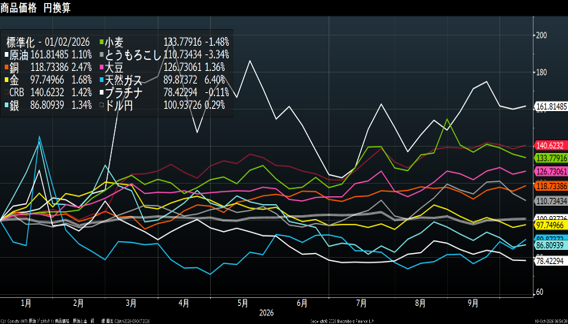
In the U.S. stock market, expectations for interest rate hikes have receded following the release of weak employment data, leading to a round of buying. Consequently, attention is now focused on the Consumer Price Index (CPI) data due on the 14th. The forecast for core CPI is around 2.4% year-on-year (YoY). Regarding crude oil prices, the projected average for September 2025 is $63.57, while the figures for September 2026 and August 2026 are $94.47 and $82.09, respectively. These represent a 48.6% increase YoY and a 15% increase month-on-month. Based solely on crude oil prices, the CPI reading could come in high. This raises the possibility that speculation regarding interest rate hikes will resurface, potentially driving up interest rates and pushing down stock prices.
Meanwhile, the U.S. earnings season kicks off this week. If earnings results fall short of market expectations, the affected companies’ stock prices will likely face selling pressure, whereas exceeding expectations would likely trigger buying.
While U.S. stocks are generally expected to trend downward next week, the performance of individual stocks will likely depend on their specific earnings results.
〇 Japanese Stocks: TOPIX Periodic Rebalancing Announcement
JPX has announced the details of the periodic rebalancing scheduled for early October 2026. The Tokyo Stock Exchange (TSE) is proceeding with a plan to reduce the number of TOPIX constituent stocks from the current 1,636 to 986 by the end of July 2028. In this review, 35 stocks were added and 683 were designated as “transition measure stocks,” resulting in a total of 1,669 TOPIX constituents as of the end of October. The 35 additions include companies such as McDonald’s Japan, Ferrotec, Toei Animation, Trial Holdings, Fukuda Denshi, and Workman; while many are listed on the Standard Market, 12 stocks were selected from the Growth Market. Last week, Goldman Sachs upgraded its investment rating for Komatsu to “Buy” and set a target price of 9,000 yen. The stock price hit an all-time high of 7,980 yen. However, the stock plunged following the announcement of a joint investigation into the agricultural machinery industry by the FTC and the U.S. Department of Agriculture, closing the week at 7,298 yen.
Personally, I believe that valuation standards in the U.S. will increasingly dictate how companies with significant global market share are priced. Komatsu appears undervalued compared to the industry leader, Caterpillar; Caterpillar has a P/E ratio of 34.5x, whereas Komatsu’s is 18.5x. Regarding ROE, Caterpillar stands at 41.6% (2025 forecast), while Komatsu is at 18.5% (as of the end of March 2026). ROE can be broken down into three components: profit margin, asset turnover, and financial leverage. The most significant difference among these three lies in financial leverage: Caterpillar has a debt-to-equity (D/E) ratio of 3.6x, compared to Komatsu’s 0.75x. Komatsu possesses substantial capacity for raising capital, and considering factors such as reconstruction demand, I believe there is strong potential for growth.
〇 Japanese Government Bonds (JGBs): Movements in the 2-Year Note
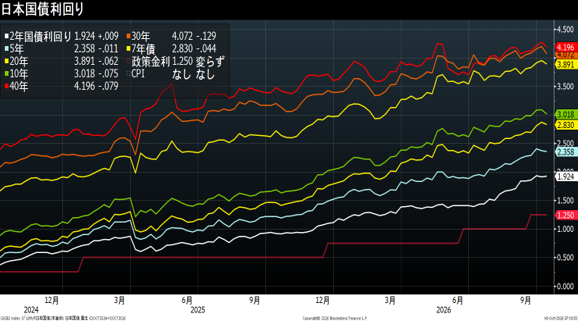
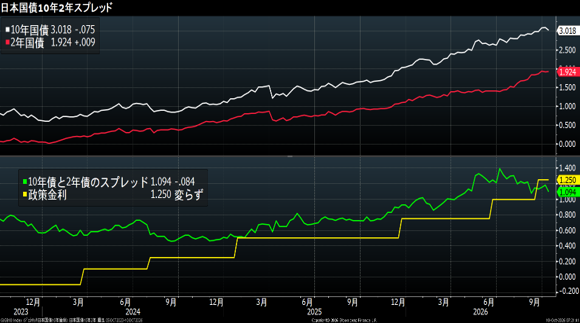
Two-year government bonds are highly sensitive to policy interest rates. Although stocks were sold off and funds flowed into bonds this week, the yield on the 2-year note rose compared to the previous week. The yield curve exhibited a “bear flattening” trend.
The Tokyo CPI—a leading indicator for the national CPI—came in at 2.7% (up 0.8% month-on-month), a level exceeding the Bank of Japan’s 2% target. It would not be surprising to see the policy interest rate raised by a total of 1% over four additional hikes.
〇 France: Escalating Fiscal Concerns
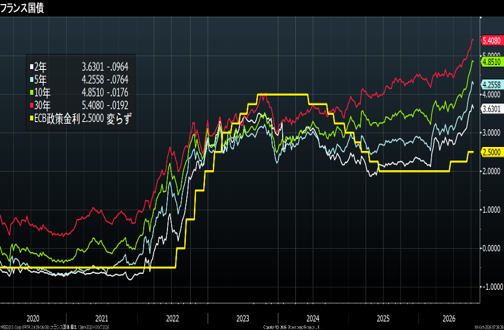
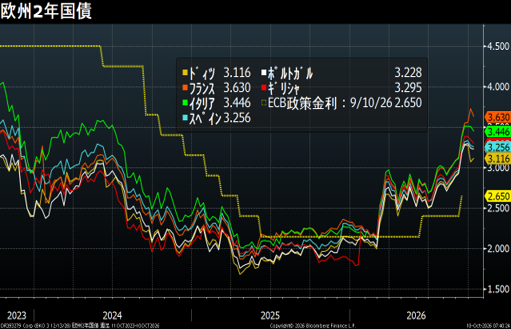
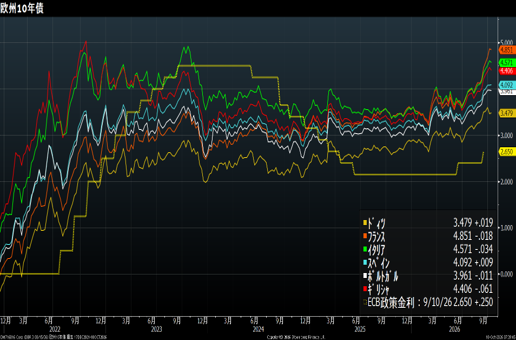
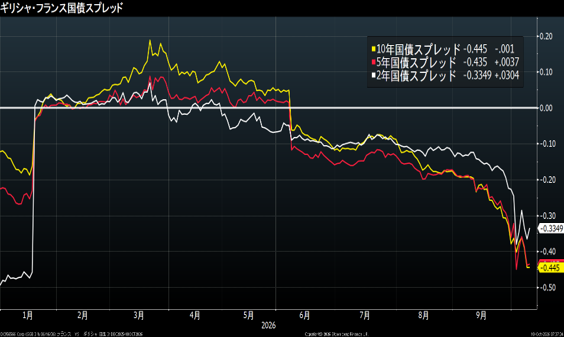
Fiscal issues in France have intensified, leading to a sell-off of French government bonds and a rise in interest rates. Yields on French government bonds are currently exceeding those of Greek government bonds, despite Greece having a lower credit rating than France.
Regarding 2-year government bond yields, France stands at 3.63%, compared to 3.29% for Greece and 3.44% for Italy; for 10-year bonds, the figures are 4.85% for France, 4.40% for Greece, and 4.57% for Italy.
Normally, the yield on Greek bonds—given Greece’s lower credit rating—should be higher than that of French bonds, yet we are currently seeing an inversion of this relationship.
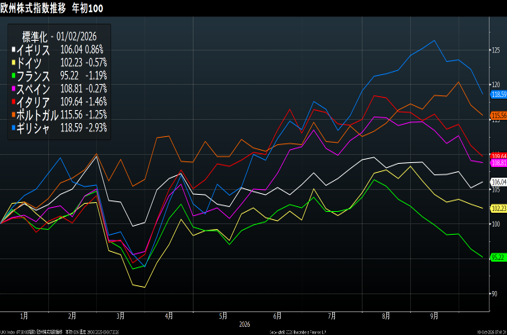
In the stock market, while other major European nations have seen positive year-to-date returns, France has recorded a decline of 4.78%, indicating an outflow of capital from the country.
*France has a population of approximately 66.7 million and a median age of 42.5 years. For every 100 people of working age (15–64), there are 26.5 individuals under the age of 15 and 36.8 aged 65 or older. The fertility rate is 1.6 births per woman. Life expectancy averages 83.7 years—86.4 years for women and 80.9 years for men. Like Japan, France is an aging society.
The age at which one begins receiving a pension in France is being raised in stages from 62 to 64. French pensions are more generous than Japan’s, generally amounting to about 50% to 60% of an individual’s take-home pay during their working years. The national pension burden associated with the aging population is a factor straining public finances. A generous pension system was one of the causes of JAL’s bankruptcy; the question remains whether France can successfully implement reforms. I believe the hurdles are high.
One hopes this does not escalate into a “second Greek crisis.” Developments in France bear close watching. *Sources: Worldometer, Population Pyramid.net
〇 Brazil: “Triple Rally” Driven by Hopes for a Change in Administration
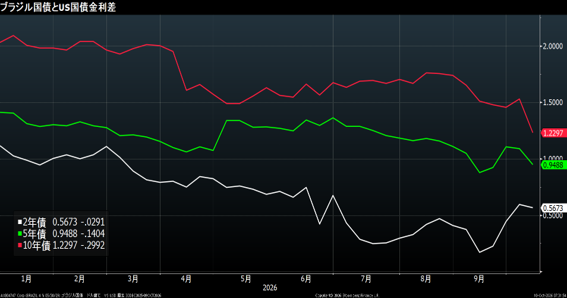
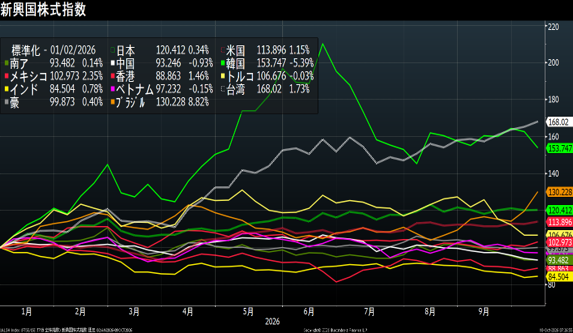
Compared to the previous week, the stock index (Bovespa Index) rose 8.82%, and the yield spread between Brazilian 10-year dollar-denominated bonds and US 10-year Treasuries narrowed to 1.2%. Brazilian ETFs listed on US stock markets climbed 14.01%. The market is optimistic about the new administration’s economic policies; it is currently the hottest market.
〇 India: Capital Outflows Underway
The Reserve Bank of India raised its policy interest rate to 5.5% due to concerns over inflation.
The Indian stock market continues to perform sluggishly. There is a clear downward trend in the assets under management of Indian mutual funds sold domestically, as capital flows out of these funds.
On the other hand, India’s IPO market is booming. Last week saw around 30 IPOs—the highest number recorded this year. Some stocks even saw their opening prices exceed their offering prices by 90%.
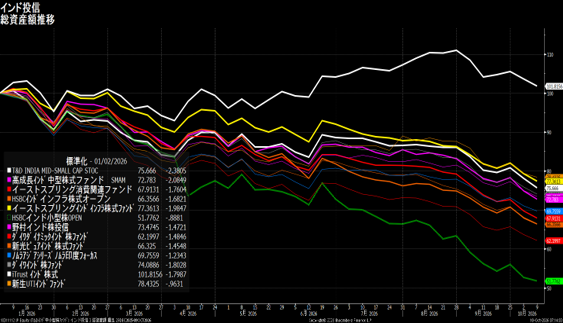
Data: Bloomberg
Certified International Investment Analyst (CIIA)
Certified Manager of Securities Analysts (CMA)
AFP
Tadashi Fujii
投稿者プロフィール

-
大学時代から株式投資をはじめ、証券会社のトレーダーとなる。以後、30年
金融畑一筋。専門分野は債券、クレジット。
日本証券アナリスト協会検定会員(CMA)、国際公認投資アナリスト(CIIA)
詳しいリンク先はこちら
 未分類2026年10月11日Will France Become the Next Greece?
- 未分類2026年10月11日フランスは第2のギリシャとなるのか
- 未分類2026年10月3日The Distorted Japanese Stock Market (Reviving the CB Market)
- 未分類2026年10月3日歪な日経平均(よみがえれCB市場)