Warning: strpos() expects parameter 1 to be string, array given in /home/tfujii46636/tadd3.com/public_html/wp-includes/compat.php on line 423
Warning: strpos() expects parameter 1 to be string, array given in /home/tfujii46636/tadd3.com/public_html/wp-includes/compat.php on line 423
Warning: preg_match() expects parameter 2 to be string, array given in /home/tfujii46636/tadd3.com/public_html/wp-includes/class-wp-block-parser.php on line 252
Warning: strlen() expects parameter 1 to be string, array given in /home/tfujii46636/tadd3.com/public_html/wp-includes/class-wp-block-parser.php on line 324
It appears the Bank of Japan has decided to raise its policy interest rate by 0.25 percentage points to 1.25% at this week’s Monetary Policy Meeting. Price fluctuations typically propagate in the order of import prices, then corporate goods prices, and finally consumer prices. Corporate goods prices for August, announced last week, rose by 7.6%. A breakdown of the figures shows that while prices for petroleum and coal products declined, there were increases in chemicals and related products, plastics, non-ferrous metals, and information and communication equipment. With crude oil prices surging in September, corporate goods prices for the month are also expected to rise. Such increases in corporate goods prices eventually lead to higher retail prices, thereby pushing up the Consumer Price Index (CPI).
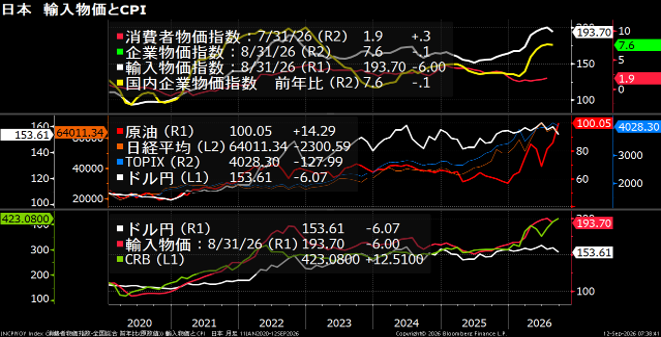
The government bond market has already priced in a 25-basis-point rate hike; the yield on 2-year government bonds stands at 1.85%, up 0.45 percentage points from the level of around 1.4% seen prior to the previous rate hike. According to a survey by Teikoku Databank, the number of food products subject to price hikes in September is around 4,900—a threefold increase from the approximately 1,400 items seen a year earlier. The average price increase is approximately 11%, driven by factors such as rising costs for raw materials, logistics, and energy, as well as the depreciation of the yen.
Food items (excluding fresh food) make the largest contribution to the CPI; in the nationwide CPI for May 2026, this category contributed a positive 0.9 percentage points year-on-year. Consequently, the September price hikes are likely to push up the CPI, suggesting a high probability that the Bank of Japan will continue to raise interest rates.
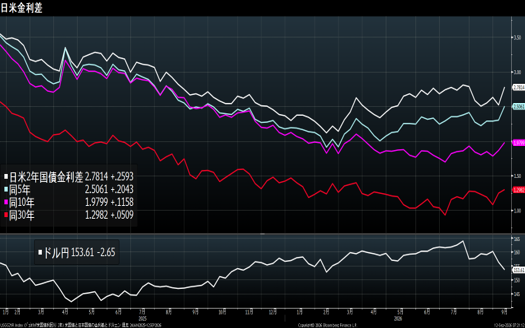
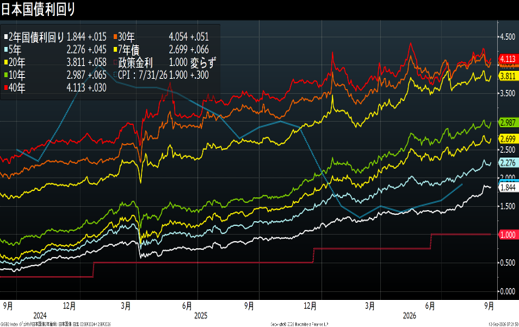
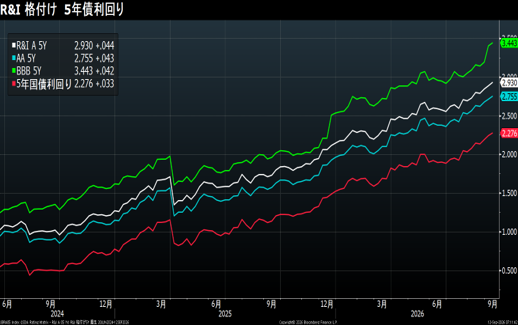
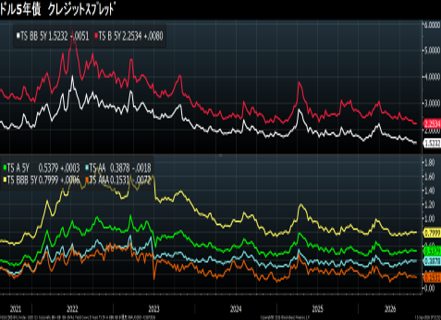
Yields on 30-year and 40-year government bonds have reached the 4% level, while the yield on 20-year bonds is approaching 3%. In the United States, too, Treasury yields have risen amid inflation concerns, with the 10-year bond yield coming within 3 basis points of the 5% mark. The interest rate differential between Japan and the U.S. widened as the rise in Japanese government bond yields outpaced that of U.S. Treasuries, causing the yen to appreciate. Rising government bond yields have a direct impact on the yields of high-rated bonds because their spreads are narrow; conversely, junk bonds are not directly affected because their wide spreads act as a cushion. In the US market, the spread between investment-grade bonds and government bonds is widening, whereas the spread for junk bonds is narrowing. (Note: If junk bond spreads begin to widen, it serves as a warning signal for the stock market.)
Since rising interest rates lead to a higher discount rate, the present value of cash flows decreases, ultimately lowering corporate value. Therefore, theoretically, rising interest rates are negative for stock prices.
Furthermore, rising interest rates can be fatal for companies with low Return on Assets (ROA). When ROA falls below the cost of debt, financial leverage works in reverse, leading to deteriorating performance for companies with high debt-to-equity (D/E) ratios. On the other hand, cash-rich companies may benefit from an “asset effect” due to rate hikes.
While the Bank of Japan (BOJ) successfully burst the real estate bubble with rapid rate hikes in the early 1990s, it went too far—an “overkill” that plunged Japan into three “lost decades.” This time, the BOJ is attempting to minimize the shock while remaining mindful of market reactions.
Japan has emerged from deflation; the only area that has not yet recovered is personal income. Japanese wages appear low compared to those at overseas companies. Unless Japanese firms raise wages, they risk losing top talent to foreign companies. To compete with overseas firms, starting salaries need to be set at an annual income of 6 million yen or more. Companies should shift their organizational structures from traditional hierarchical models to “job-based” systems. Japanese firms should also abandon wasteful job rotation practices and focus instead on cultivating specialists.
・NT Ratio: The NT ratio has declined.
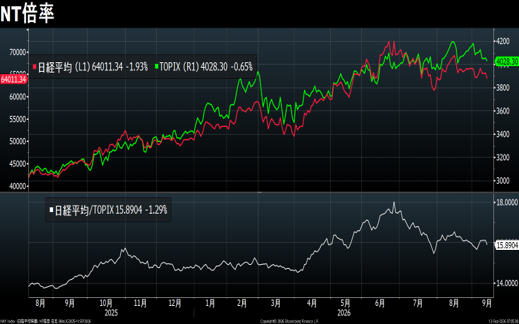
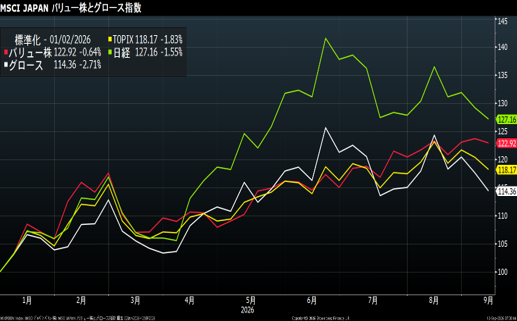
Last week, the Nikkei Stock Average fell by 1.93% while the TOPIX fell by 0.65%, causing the NT ratio to contract to 15.89x. Value stocks remained resilient while growth stocks were sold off. Among the 33 TOPIX industry sectors, the Oil & Coal Products index recorded the highest gain at 7.79% (compared to the TOPIX’s -1.83%), followed by the Information & Communication sector index at 4.44% and the Mining index at 3.53%. Shares of Idemitsu Kosan rose 12.11% week-on-week (TOPIX: -1.83%) as the market reacted favorably to rising crude oil prices.
・Stocks trading below 1x PBR: 547 issues (up 31 from the previous week)
When growth stocks are volatile, capital tends to flow into undervalued stocks. With the ex-dividend date for September interim dividends approaching, undervalued and high-dividend stocks are likely to show solid performance this week and next.
Among TOPIX constituents, the number of companies trading below a Price-to-Book Ratio (PBR) of 1x stood at 547, an increase of 31 from the previous week. Among these stocks, Albis saw the largest price gain at 49.7%, followed by Shikoku Bank (9.30%) and Yamagata Bank (7.60%). (The average performance for the group of stocks trading below 1x PBR was -2.0%.)
The top 10 list included four regional banks and three electric power/gas companies.
〇 Sectors with stocks trading below 1x PBR
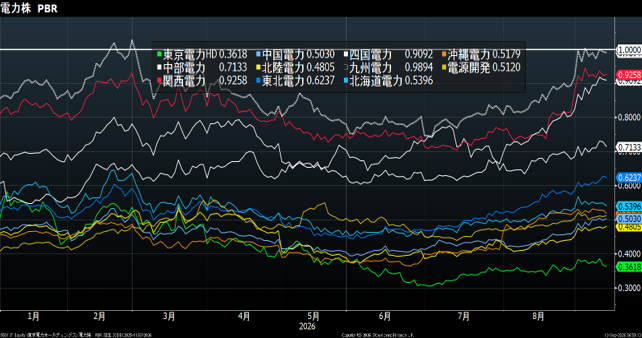
・Electric Power: All stocks trading below 1x PBR
Currently, every stock in the electric power sector is trading below a PBR of 1x. Amidst this, Kyushu Electric Power’s share price has risen to the verge of reaching the 1x PBR level.
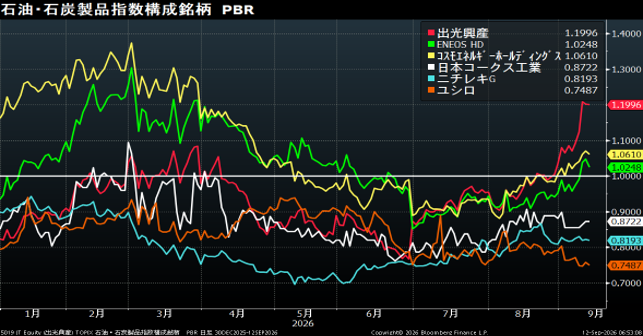
・Oil & Coal Products
Among stocks in this sector, Idemitsu Kosan (1.19x), Cosmo Energy Holdings (1.06x), and ENEOS (1.02x) are trading above 1x PBR. The other three stocks in the sector remain flat at around 0.8x PBR.・Regional Banks
Yamagata Bank’s share price rose 0.76% week-on-week, pushing its PBR up to 0.9925x. Meanwhile, Shimizu Bank—which holds the lowest PBR among TOPIX constituents—saw its ratio fall to 0.43x.
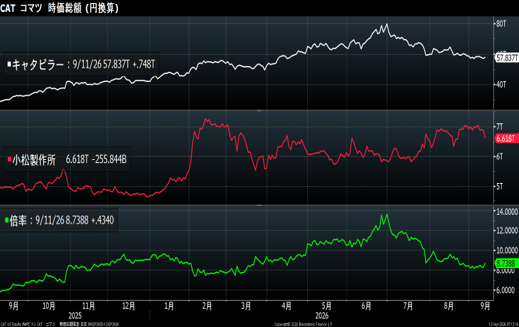
・Caterpillar-Komatsu Ratio: Widened to 8.73x
The ratio widened due to a sharp drop in Komatsu’s share price. However, there is no need for concern; buying activity aimed at securing dividends is expected over the coming weeks. Komatsu shares remain undervalued.
・India
India’s IPO market is booming.
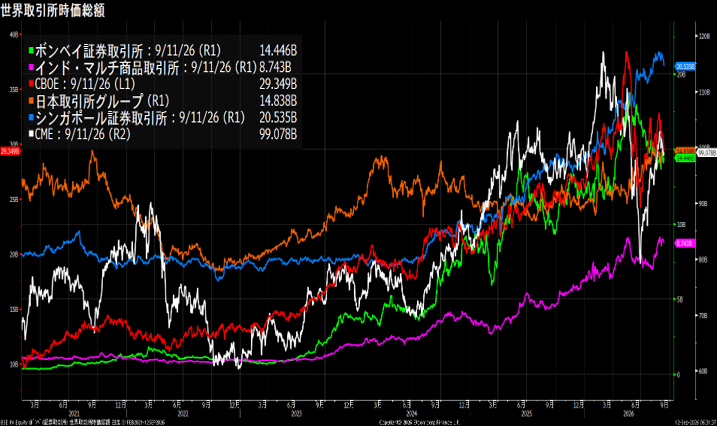
The IPO for India’s largest stock exchange, the National Stock Exchange (NSE), has finally launched. The price band has been set at 1,700–1,785 rupees, with a projected market capitalization of up to 4.418 trillion rupees (US$46.17 billion). This scale is approximately three times that of the already-listed Bombay Stock Exchange (US$14.446 billion) or Japan Exchange Group (US$14.83 billion). The subscription period runs from September 17 to 21, involving 126.44 million shares.
The IPO market is highly active this week. Notably, shares of chemical manufacturer Shanti Inorganics Ltd and apparel maker Farm Peace Ltd opened at levels 90% above their offering prices. It appears that capital is flowing into the Indian IPO market.
For information on India:
Orion Global Ventures – Orion Global Ventures
Data: Bloomberg
Certified International Investment Analyst (CIIA)
Certified Securities Analysts Association (CMA)
AFP
Tadashi Fujii
投稿者プロフィール

-
大学時代から株式投資をはじめ、証券会社のトレーダーとなる。以後、30年
金融畑一筋。専門分野は債券、クレジット。
日本証券アナリスト協会検定会員(CMA)、国際公認投資アナリスト(CIIA)
詳しいリンク先はこちら
 未分類2026年10月11日Will France Become the Next Greece?
- 未分類2026年10月11日フランスは第2のギリシャとなるのか
- 未分類2026年10月3日The Distorted Japanese Stock Market (Reviving the CB Market)
- 未分類2026年10月3日歪な日経平均(よみがえれCB市場)