Warning: strpos() expects parameter 1 to be string, array given in /home/tfujii46636/tadd3.com/public_html/wp-includes/compat.php on line 423
Warning: strpos() expects parameter 1 to be string, array given in /home/tfujii46636/tadd3.com/public_html/wp-includes/compat.php on line 423
Warning: preg_match() expects parameter 2 to be string, array given in /home/tfujii46636/tadd3.com/public_html/wp-includes/class-wp-block-parser.php on line 252
Warning: strlen() expects parameter 1 to be string, array given in /home/tfujii46636/tadd3.com/public_html/wp-includes/class-wp-block-parser.php on line 324
The Nikkei Average saw wild fluctuations this week. It ranged from a high of 71,952.99 yen to a low of 68,461.10 yen—a spread of 4,370.63 yen. For context, the average weekly trading range over the past five years has been 1,340 yen; the widest spread was 5,169.77 yen (week of June 15, 2026), and the narrowest was 261.97 yen (first week of May 2023).
Daily volatility was also high this week, with an average daily range of 2,433.57 yen. The movement on June 26 was particularly abnormal, with a range of 3,146.43 yen.
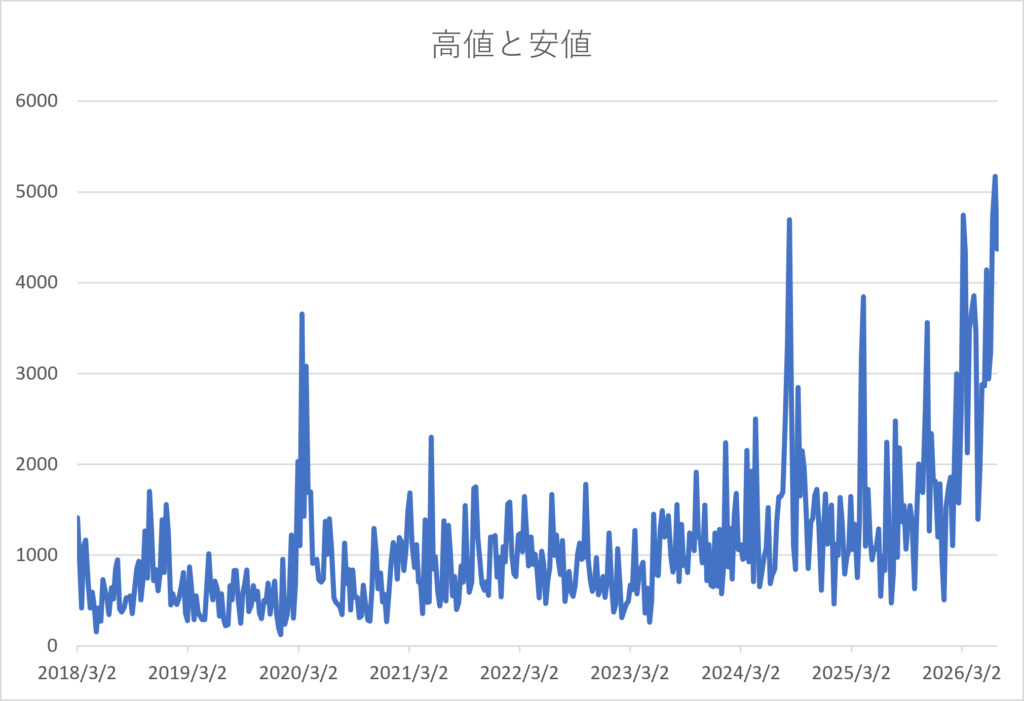
Why does it move so drastically? The reason lies in the Nikkei Average’s calculation method. Because it is calculated using a simple average, the index is highly susceptible to the influence of high-priced stocks. Price movements in stocks such as Advantest, SoftBank Group, Kioxia, Tokyo Electron, Fujikura, Fanuc, Shin-Etsu Chemical, Lasertec, and Disco are directly reflected in the index.
On the 26th, the Nikkei Average fell by approximately 3,000 yen. Of that drop, Advantest accounted for about 835 yen, SoftBank for about 717 yen, Kioxia for about 273 yen, and Tokyo Electron for about 243 yen; these four stocks alone contributed to a decline of roughly 2,000 yen.
Hedge funds manipulate the Nikkei Average by placing massive buy and sell orders on these specific stocks. It looks like we can expect significant volatility next week as well.
Hedge funds are treating the Nikkei Average like a “cornered stock” (a stock subject to speculative manipulation). To defeat them, the trading method for the 20 stocks with the highest impact on the index should be reverted to the old-fashioned open-outcry style. Doing so would make it impossible to manipulate the Nikkei Average or execute arbitrage trades involving futures and options. If you hold overpriced stocks, you might want to consider offloading them. The AI bubble could be on the verge of bursting.
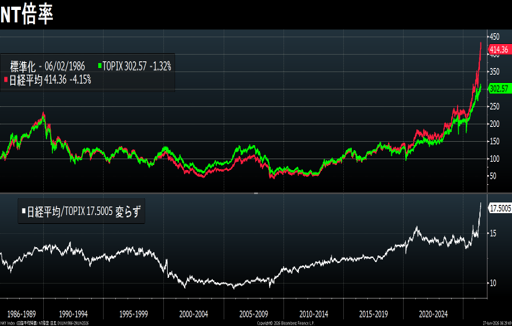
〇 Japan: NT Ratio at 17.50x
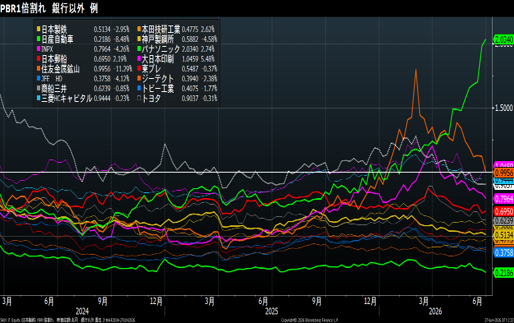
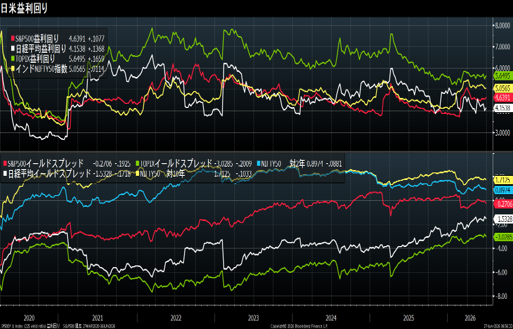
The NT ratio has widened due to the Nikkei Average’s sharp rise, making TOPIX stocks appear to be lagging behind. It may be time to start accumulating undervalued stocks. Among TOPIX constituents, 587 stocks are trading below a price-to-book (PBR) ratio of 1.0x. The TOPIX yield spread stands at -3%, suggesting the market is undervalued. If the AI-driven rally collapses, capital is likely to shift toward these undervalued stocks.
〇 US Stocks: Risk-Off Sentiment
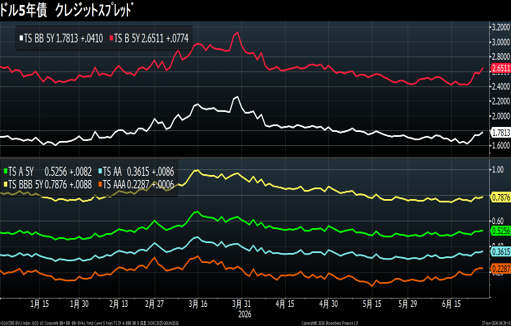
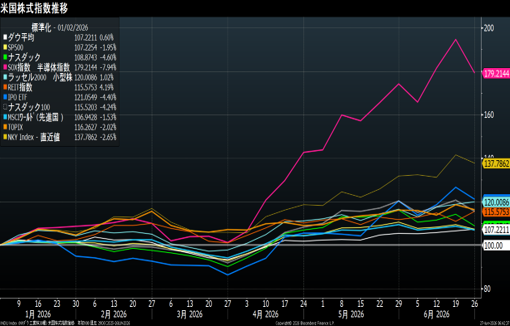
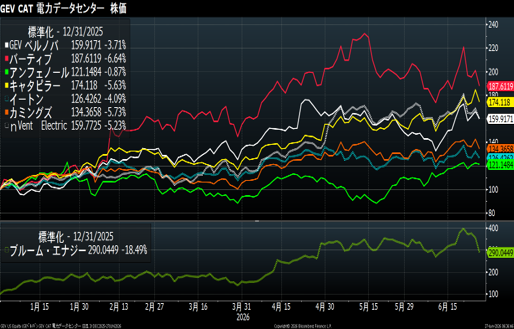
The “T-spread” (yield spread over Treasuries) for junk bonds has widened, signaling a risk-off move. The semiconductor index fell 7.9% week-over-week, and AI-related stocks also declined. Capital is flowing into government bonds and investment-grade corporate bonds.
Next week brings the release of employment data, and the risk-off trend is likely to continue.
〇 SpaceX Corporate Bonds: Lackluster Demand
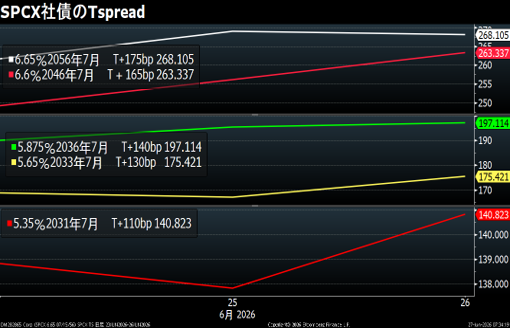
On the 23rd, SpaceX issued five tranches of bonds with maturities ranging from 5 to 30 years. The total issuance volume was a massive $25 billion (approximately 4 trillion yen).
Demand in the secondary market has been weak, and spreads over government bonds are widening. Although the bonds carry a BBB rating, they are trading at spreads closer to BB-rated debt.
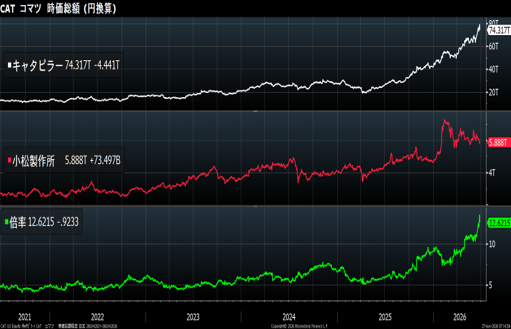
〇 Caterpillar-Komatsu Ratio
Caterpillar’s market capitalization stands at 74.31 trillion yen, which is 12.62 times that of Komatsu (5.88 trillion yen). The ratio has narrowed slightly as Caterpillar shares were sold off and Komatsu shares were bought. This gap is likely to shrink further as reconstruction efforts materialize.
〇 India: Falling Oil Prices Provide a Tailwind
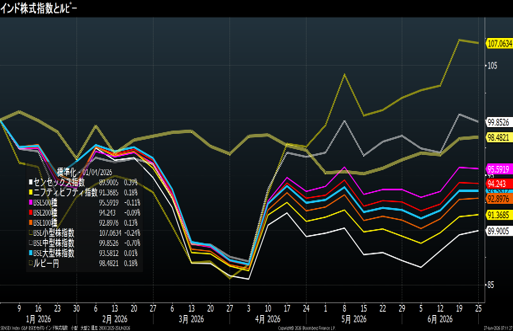
Oil prices have dropped, and the rupee is seeing renewed buying interest. Meanwhile, foreign investors continue to sell Indian equities.
The Indian economy is set for continued expansion. A dollar-cost averaging (systematic investment) approach is ideal for investing in Indian stocks. India today is like Japan in the 1950s. Penetration rates for appliances such as washing machines, refrigerators, and air conditioners remain low, but are rising alongside the growth of the middle class.
Prime Minister Modi has announced a bid to host the 2036 Summer Olympics. If the bid is successful, the development of road and rail infrastructure will accelerate.
Data: Bloomberg
Certified International Investment Analyst (CIIA)
Certified Securities Analysts Association (CMA)
AFP
Tadashi Fujii
投稿者プロフィール

-
大学時代から株式投資をはじめ、証券会社のトレーダーとなる。以後、30年
金融畑一筋。専門分野は債券、クレジット。
日本証券アナリスト協会検定会員(CMA)、国際公認投資アナリスト(CIIA)
詳しいリンク先はこちら
 未分類2026年10月3日The Distorted Japanese Stock Market (Reviving the CB Market)
- 未分類2026年10月3日歪な日経平均(よみがえれCB市場)
- 未分類2026年9月26日Number of Stocks with PBR Below 1.0x Falls Below 500
- 未分類2026年9月26日PBR1割れ 500銘柄を下回る