Warning: strpos() expects parameter 1 to be string, array given in /home/tfujii46636/tadd3.com/public_html/wp-includes/compat.php on line 423
Warning: strpos() expects parameter 1 to be string, array given in /home/tfujii46636/tadd3.com/public_html/wp-includes/compat.php on line 423
Warning: preg_match() expects parameter 2 to be string, array given in /home/tfujii46636/tadd3.com/public_html/wp-includes/class-wp-block-parser.php on line 252
Warning: strlen() expects parameter 1 to be string, array given in /home/tfujii46636/tadd3.com/public_html/wp-includes/class-wp-block-parser.php on line 324
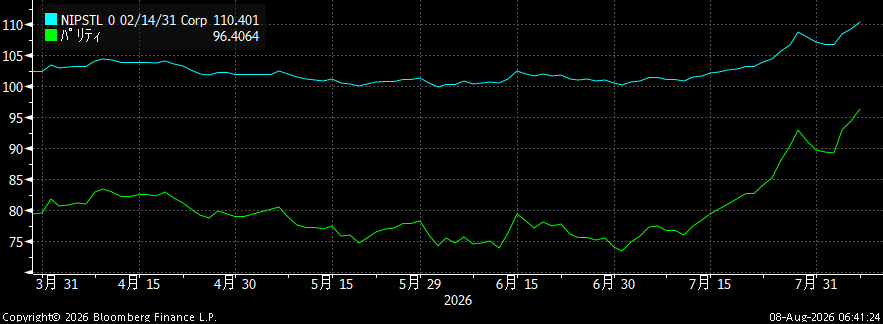
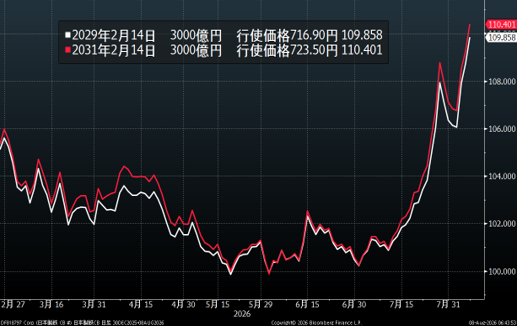
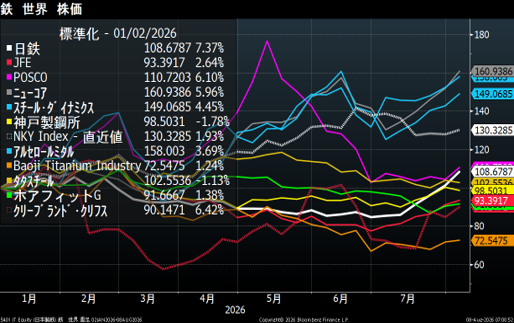
Nippon Steel’s share price has risen, driven by strong earnings. While the company’s Euro-yen convertible bonds (CBs) also appreciated alongside the stock, their rate of increase lagged behind the share price, resulting in a narrowing of the divergence rate (premium). Nippon Steel has two outstanding Euro-yen CB issues: one maturing in 2029 and another in 2031. A key characteristic of these CBs is their low conversion price settings; initially, the conversion prices were set at 10% above the reference share price for the 2029 issue and 11.01% above for the 2031 issue. A conversion price close to the market share price implies a higher probability of conversion compared to issues with higher conversion prices, which can act as a drag on the stock price. When a CB is converted, the debt transforms into equity, eliminating the need for cash repayment; this strengthens the issuer’s capital base while avoiding debt repayment obligations. Furthermore, issuance fees are borne by investors. Successful conversion improves the issuing company’s financial health—a strategy notably employed by Tesla.
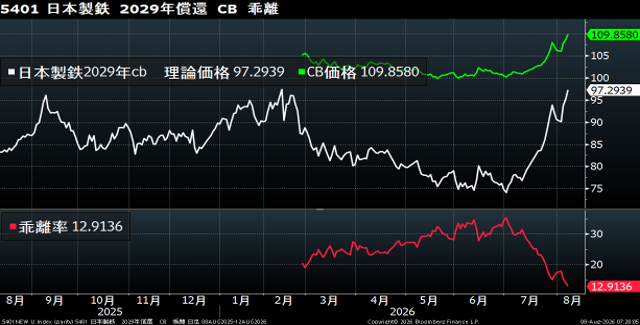
A recent trend in the CB market is that the price level triggering “negative divergence” (where the CB trades below its theoretical value relative to the stock) has been rising, and conversions often accelerate in the two to three months prior to maturity.
The divergence rate (CB premium) shrinks as the share price approaches the conversion price. Once the share price exceeds the conversion price and the CB’s theoretical value significantly surpasses its face value (e.g., reaching 150), the bond’s face value of 100 becomes a focal point; the bond enters a state of negative divergence, and conversion activity picks up.
In late June, the divergence rates for both the 2029 and 2031 issues exceeded 30%. Currently, the rates stand at 12.91% for the 2029 issue and 14.51% for the 2031 issue. The conversion prices are 716.90 yen for the 2029 issue and 723.50 yen for the 2031 issue. With the stock price at 697.50 yen, the parity (theoretical price) stands at 97.29 for the 2029 bonds and 96.40 for the 2031 bonds.
The conversion deadline for the 2029 bonds is January 31, 2029, leaving a remaining term of approximately 2.48 years. As the stock price approaches or exceeds the conversion price, the delta increases, leading to heavier hedge selling.
A new catalyst is needed to push the stock price higher. US Steel’s earnings show promise for future growth. The India business also holds potential; if India is selected to host the 2036 Summer Olympics, rapid development of road and rail networks could follow. The host for the 2036 Games will be decided by 2029.
Although Nippon Steel’s stock price has not yet reached the conversion level, the gap is narrowing rapidly, so it is important to monitor this trend.
Conversion would have a positive impact on Nippon Steel’s stock price.
Now is the time to accumulate shares!
〇 Japanese Stocks: Value Investing
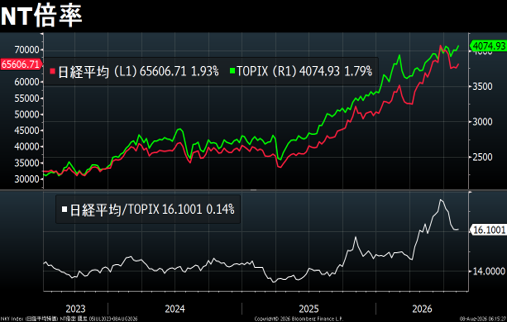
The NT ratio stands at 16.10x, widening slightly from 16.07x at the end of last week. This was driven by strong earnings from Fujikura on Friday, which boosted the Nikkei Average. This week, the MSCI Growth Index outperformed the MSCI Value Index in both Japan and the US.
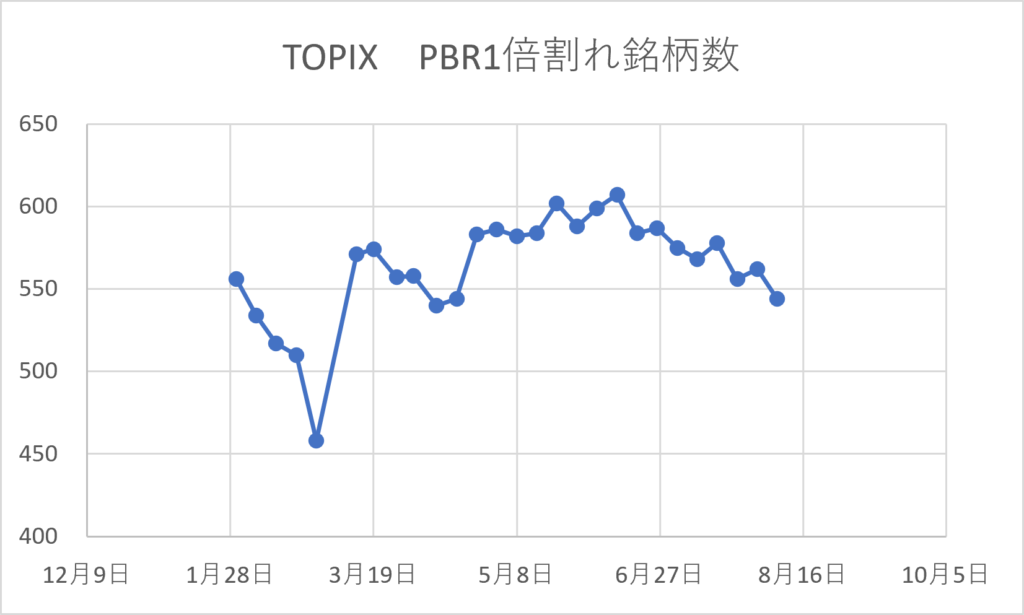
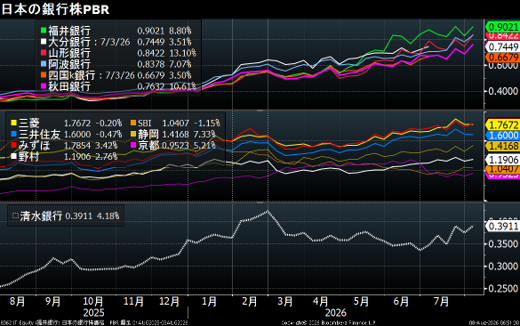
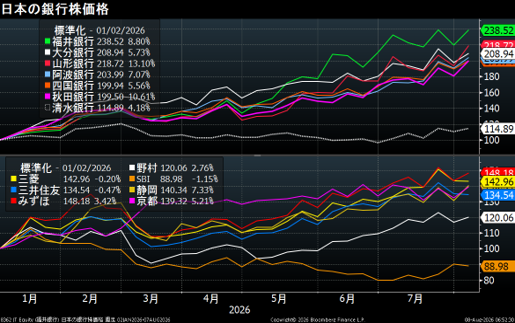
The number of TOPIX-listed stocks trading below a PBR of 1x is 544, a decrease of 18 from the end of last week—a level not seen since mid-April. Capital appears to be flowing into stocks trading at or near a PBR of 1x. Notably, regional bank stocks trading below a PBR of 1x have seen significant price gains. Week-on-week price increases include Yamagata Bank (PBR 0.84x) at 13.1%, Akita Bank (PBR 0.76x) at 10.61%, and Fukui Bank (PBR 0.90x) at 8.80%. Mitsubishi UFJ Financial Group (already trading above a PBR of 1) fell 0.20%, while Sumitomo Mitsui Financial Group dropped 0.47%.
Based on market capitalization, the top five stocks trading below a PBR of 1.0x are Toyota (0.95x), Honda (0.53x), Japan Post Holdings (0.66x), Denso (0.95x), and INPEX (0.80x).
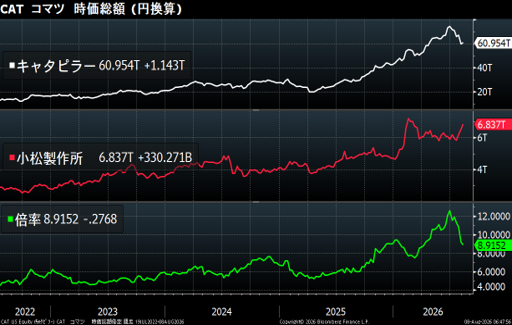
〇 Komatsu & Caterpillar: P/E Ratio of 8.9x
Both Caterpillar and Komatsu announced strong earnings. Although Caterpillar’s stock price surged immediately after the announcement, it subsequently lost momentum; the market appears to be correcting what it deemed an overvaluation.
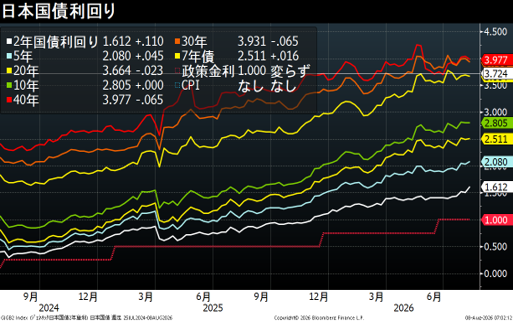
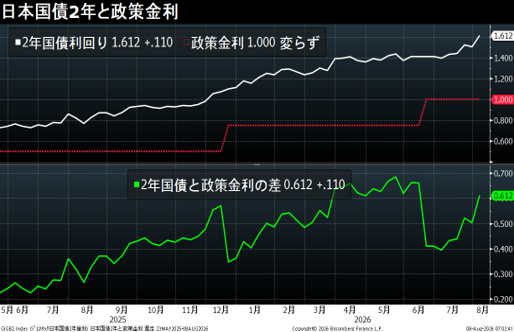
〇 Japanese Government Bonds (JGBs): Notable Movement in 2-Year Bonds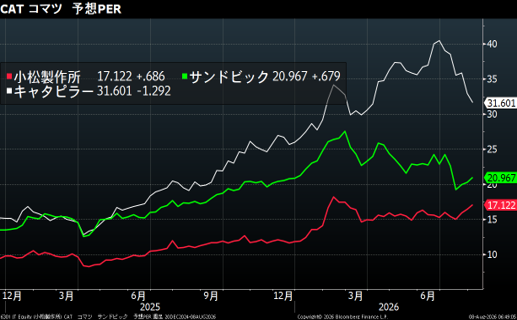
Yields on 2-year JGBs have risen, causing the spread between 10-year and 2-year yields to narrow. 2-year bonds are sensitive to the policy interest rate, and the market is moving in anticipation of rate hikes.
Despite coordinated intervention by Japan and the US in the currency markets, the USD/JPY exchange rate remains in the 157 range. If authorities are serious—and considering the thin market liquidity during the Obon holiday—intervention is likely to occur next week. Halting the depreciation of the yen is essential to curbing the rise in import prices.
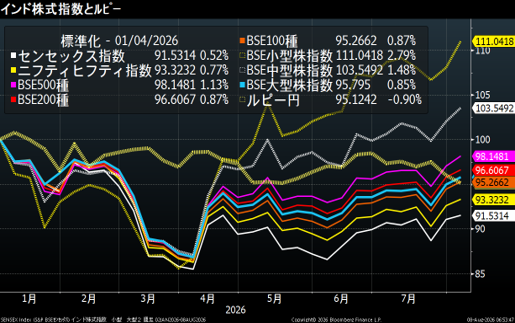
〇 India: Small-Cap Index Surges
Indian small-cap indices are seeing strong buying interest. Consequently, the net asset values (NAVs) of Indian small-cap funds sold in Japan have risen. While many funds have posted negative year-to-date returns, the “HSBC India Small-Cap Open” fund saw its NAV rise 2.47% week-on-week, achieving a solid year-to-date return of 9.67%.
〇 Solutions for Japan’s Fiscal Issues
The deterioration of Japan’s fiscal health is driven by an aging population and excessive medical care. The population of bedridden elderly individuals is reportedly around 2.48 million. Assuming a monthly pension of 100,000 yen per person, the total monthly pension payout amounts to 248 billion yen, or 2.9 trillion yen annually. Furthermore, thanks to the high-cost medical expense system, there are monthly caps on out-of-pocket medical payments: 35,400 yen for households exempt from resident tax, and 57,600 yen for those with annual incomes between approximately 1.56 million and 3.7 million yen. A gap arises between pension income and medical costs, and I believe this contributes to the issue of excessive medical treatment.
The issue of bedridden elderly patients and medical care is incredibly complex, yet Japan’s fiscal health cannot improve unless this vicious cycle is broken. You do not see bedridden elderly people in other parts of the world; it is a truly difficult problem.
While medical advancements are certainly welcome, we must question whether excessive medical intervention for bedridden elderly patients is truly necessary.
This is a matter for political judgment. The current Liberal Democratic Party (LDP) is unlikely to address it. I assisted Mr. Mitsuru Imamura during the last House of Representatives election because he holds an impressive background—having studied at the University of Tokyo’s prestigious Faculty of Medicine (Science III) and Harvard—and questions the practice of excessive medical treatment.
Data: Bloomberg
Certified International Investment Analyst (CIIA)
Certified Manager of Securities Analysts (CMA)
AFP
Tadashi Fujii
投稿者プロフィール

-
大学時代から株式投資をはじめ、証券会社のトレーダーとなる。以後、30年
金融畑一筋。専門分野は債券、クレジット。
日本証券アナリスト協会検定会員(CMA)、国際公認投資アナリスト(CIIA)
詳しいリンク先はこちら
 未分類2026年8月8日Nippon Steel’s convertible bonds are on the move!
- 未分類2026年8月8日日本製鉄CB、乖離率縮小、29年債は12%台に
- 未分類2026年8月1日Toyota’s PBR has risen above 1x—who’s next?
- 未分類2026年8月1日トヨタのPBRが1倍超え、次は誰だ!