Warning: strpos() expects parameter 1 to be string, array given in /home/tfujii46636/tadd3.com/public_html/wp-includes/compat.php on line 423
Warning: strpos() expects parameter 1 to be string, array given in /home/tfujii46636/tadd3.com/public_html/wp-includes/compat.php on line 423
Warning: preg_match() expects parameter 2 to be string, array given in /home/tfujii46636/tadd3.com/public_html/wp-includes/class-wp-block-parser.php on line 252
Warning: strlen() expects parameter 1 to be string, array given in /home/tfujii46636/tadd3.com/public_html/wp-includes/class-wp-block-parser.php on line 324
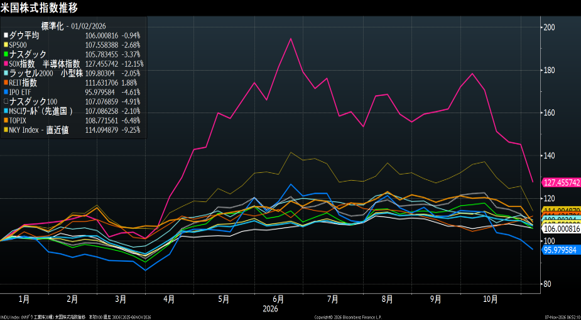
In the U.S., the AI bubble has burst. The semiconductor index (SOX index) plummeted 12.15% week-on-week. Even so, it remains up 27.45% year-to-date, suggesting there may be further room for it to fall in the coming weeks.
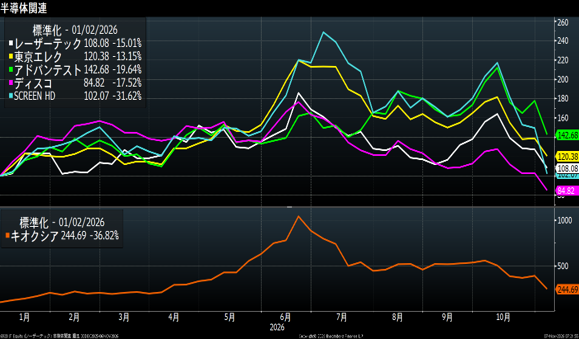
The crash in the U.S. stock market has spilled over into Japan, with the Nikkei Stock Average dropping 9.25% week-on-week. Semiconductor-related stocks have been hit particularly hard: Kioxia fell 36.82%, SCREEN HD 31.62%, Advantest 19.64%, Disco 17.52%, Lasertec 15.01%, and Tokyo Electron 13.15%—all suffering significant declines.
Kioxia’s projected P/E ratio is a staggering 2.75x—and that’s the P/E, not the P/B ratio. It’s a dire level. With an EPS of 3,097.8 yen, it’s hard to imagine the stock price falling quite that far.
As semiconductor and AI-related stocks crash globally, capital is already beginning to shift toward the next markets: India and China.
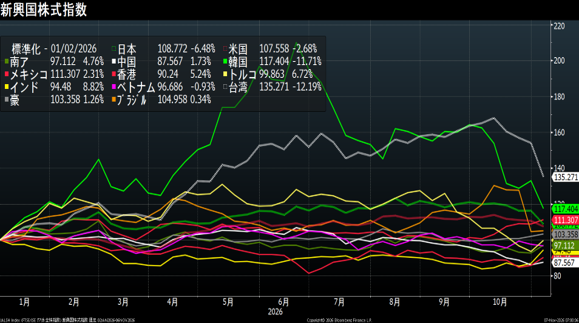
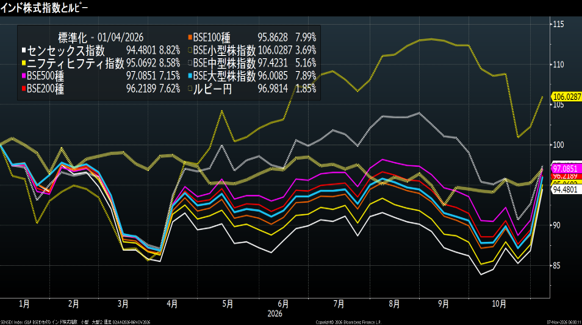
Among emerging markets this week—even as indices in Taiwan and South Korea declined—India rose 8.82%, Turkey 6.72%, and Hong Kong 5.24%.
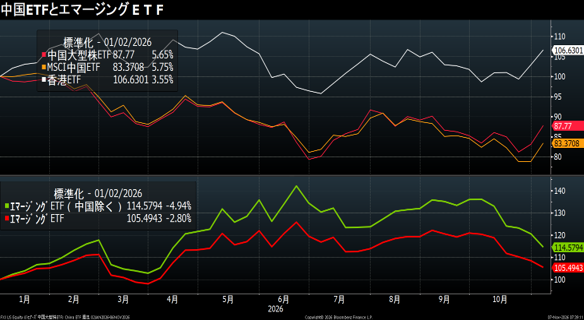
While emerging market ETFs fell 2.80% week-on-week, those excluding China dropped 4.94%.
In the Chinese market, banking stocks are seeing buying interest; the share prices of China’s five largest banks are currently hovering near their highs.
In India, foreign investors have shifted to net buyers. Large-cap indices have surged, with both the Sensex and Nifty
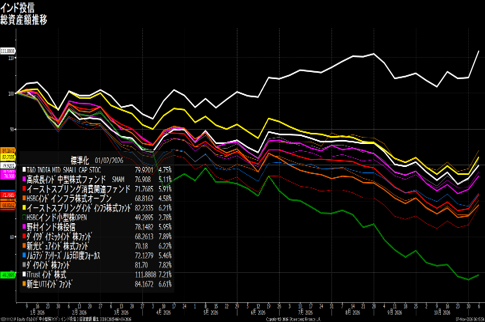
indices climbing more than 8.5% week-on-week. The net asset values (NAVs) of India-related funds sold in Japan have risen, accompanied by an increase in their total assets.
The Eastspring India Equity Fund saw an inflow of just under 20 billion yen over the past week. Other notable inflows include 19.22 billion yen for the Nomura India Equity Fund, 12.56 billion yen for the Daiwa Dynamic India Equity Fund, and 11.08 billion yen for the Eastspring India Consumer-Related Fund.
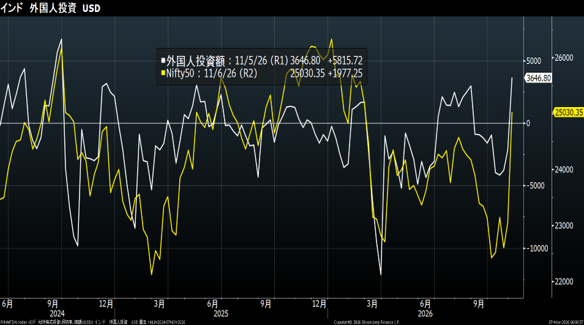
Indian equities are likely to attract significant attention next year. India has been included in the list of countries expressing interest in hosting the 2036 Summer Olympics, as announced by the International Olympic Committee (IOC) on November 2. A final decision is expected by mid-2029.
Should India be selected, it would trigger a massive expansion of infrastructure. India is the frontrunner, with Qatar and South Africa as its primary rivals; given the potential economic impact, India appears to be the most logical choice.
Since direct investment in Indian stocks is not possible, a steady, incremental investment approach (dollar-cost averaging) is recommended.
・Japanese Equities: The Drawbacks of the Nikkei 225
The flawed calculation method used for the Nikkei 225 is the root cause of the current unfavorable situation.
The Nikkei 225 is highly sensitive to the performance of a select few stocks. Individual investors should avoid Nikkei 225 futures and options—it is essentially a form of gambling.
〇 Yield Spread: The TOPIX Appears Undervalued
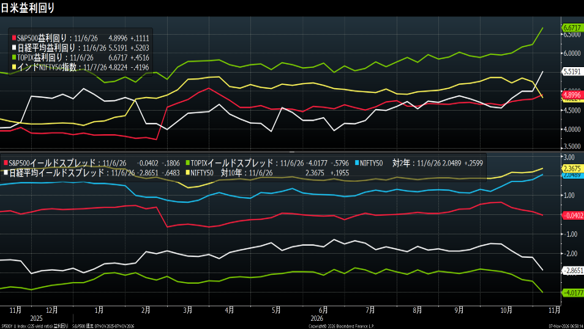
Regarding the yield spread for stock indices in Japan and the U.S., the S&P 500 stands at -0.04%, the TOPIX at -4.01%, and the Nikkei 225 at -2.86%.
For the S&P 500, the combination of a decline in the index and falling bond yields has pushed the figure into negative territory, suggesting that stocks have reached an undervalued level. Both the Nikkei 225 and the TOPIX currently show negative earnings yields, with the TOPIX appearing particularly undervalued. 〇 Stocks with a PBR below 1.0x: 666 (up from 596 the previous week)
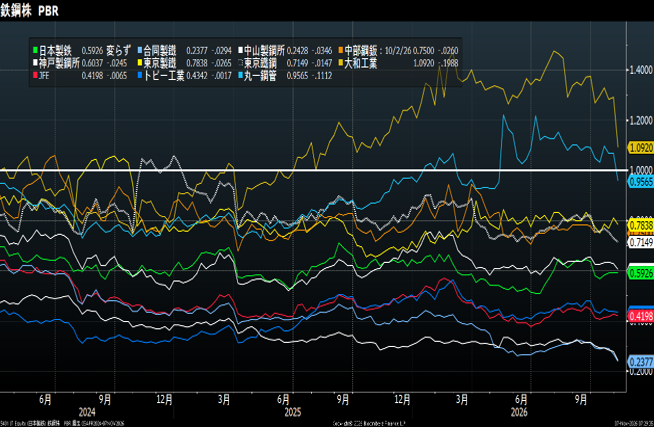
Among the constituents of the TOPIX index, 666 stocks currently have a price-to-book ratio (PBR) below 1.0x—the highest weekly figure seen this year.
The stock market saw a broad-based decline this week. I believe that companies with strong earnings and a PBR below 1.0x will continue to attract buying interest into next year and beyond.
This presents a buying opportunity.
〇 Caterpillar-Komatsu Ratio: 5.30x
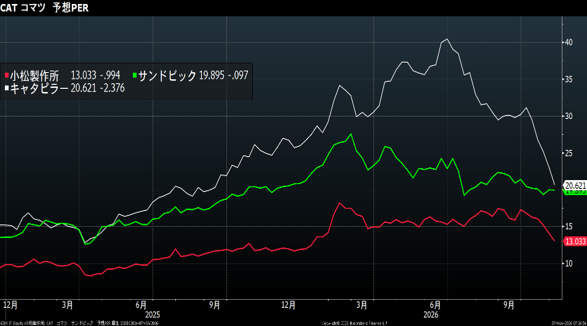
At one point, Caterpillar was touted as an “AI-related” stock, pushing its share price above the $1,000 mark. However, as the “AI bubble” burst, the stock price plummeted, with its market capitalization falling from 74 trillion yen to 40.46 trillion yen. Its price-to-earnings (PER) ratio has dropped from 40x to 20x. Given that Sandvik—a company unaffected by the AI bubble—also trades at a PER of approximately 20x, it is possible that the decline in Caterpillar’s share price may be nearing its end.
〇 October U.S. CPI:
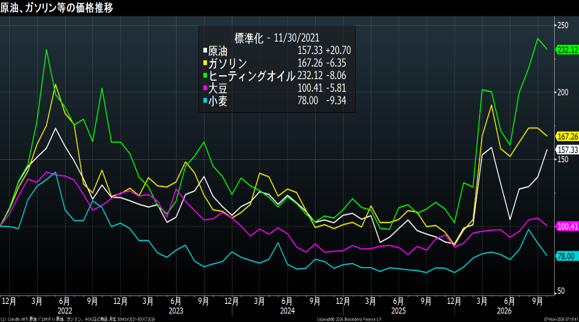
The U.S. Consumer Price Index (CPI) for October is set to be released next week. While crude oil prices rose by 20% compared to September, gasoline prices fell by 6.35%, soybeans by 5.8%, and wheat by 9.8%. According to an AI analysis, gasoline prices have a greater impact on the CPI than crude oil prices do. Consequently, the October CPI figure could come in relatively subdued. This would suggest that further interest rate hikes are less likely, which could, in turn, drive buying in the stock market. Come on, AI—let’s hope that’s the case!
For information on India:
Orion Global Ventures – Orion Global Ventures
Data: Bloomberg
Certified International Investment Analyst (CIIA)
Certified Securities Analysts Association (CMA)
AFP
Tadashi Fujii
投稿者プロフィール

-
大学時代から株式投資をはじめ、証券会社のトレーダーとなる。以後、30年
金融畑一筋。専門分野は債券、クレジット。
日本証券アナリスト協会検定会員(CMA)、国際公認投資アナリスト(CIIA)
詳しいリンク先はこちら